

If you’ve been shopping the family SUV lot lately, you’ve probably noticed both of these getting a lot of buzz.
That’s not an accident — the Telluride and Palisade are corporate cousins, built on the same bones by parent company Hyundai Motor Group, and for years they’ve been the two best-selling three-row SUVs for anyone who wants Toyota Highlander space without the Toyota Highlander price tag.
But 2027 is a genuinely interesting year to cross-shop them, because they’re no longer identical twins wearing different badges.
The Telluride just went through a full ground-up redesign — new platform tweaks, a new engine lineup, a longer body — while the Palisade is cruising into its second model year on the redesign it got for 2026.
That means the Telluride is the newer, more thoroughly updated of the two right now, even though they’ll still get cross-shopped at the same dealer groups.
If you’re weighing these two for driveways around Omaha — where winters mean you actually use the AWD, and where a 30-40 minute commute out to the suburbs makes real-world MPG matter — here’s how they actually stack up.
The Quick Take
| 2027 Kia Telluride | 2027 Hyundai Palisade | |
|---|---|---|
| Base engine | 2.5L turbo-4, 274 hp | 3.5L V6, 287 hp |
| Hybrid option | 2.5L turbo hybrid, 329 hp | 2.5L turbo hybrid, 329 hp |
| Starting price | ~$39,190 | Expected to hold near current pricing |
| 0-60 mph (gas) | ~7.4 sec | 7.9-8.8 sec (V6) |
| Towing (max) | 5,000 lbs | 5,000 lbs (V6) / 4,000 lbs (hybrid) |
| Design language | Boxier, rugged, EV9-inspired | Boxier, upright, luxury-leaning |
| Seating | 7-8 (hybrid limited to 7) | 7-8 |
What Changed Under the Hood
This is really where the two vehicles diverge. For over a decade, both of these rode on the same naturally aspirated V6. Not anymore.
Kia went all-in on turbocharging. The 2027 Telluride drops the old 291-hp V6 entirely. Every gas Telluride now uses a 2.5-liter turbocharged four-cylinder making 274 hp and 311 lb-ft of torque, paired with an 8-speed automatic.
On paper that’s fewer horses, but there’s meaningfully more low-end torque, which is what you actually feel at stoplights and on onramps. There’s also a new turbo-hybrid making 329 hp and 339 lb-ft, run through a 6-speed automatic.
Hyundai kept the V6 around — for now. The Palisade still offers a 3.5-liter naturally aspirated V6 (287 hp, 260 lb-ft) as the base engine, alongside its own version of the 329-hp turbo-hybrid. Worth being honest about this one: the V6 is the older of the two approaches here.
It’s slower to 60 (7.9 to 8.8 seconds depending on trim and weight), it’s down on torque compared to Kia’s turbo-four, and it doesn’t return meaningfully better fuel economy to justify the extra weight.
Kia essentially made the call for its whole lineup that Hyundai has only made for half of its Palisade trims — and the Telluride’s standard turbo-four backs that up with a quicker 0-60 time than even the Palisade’s base engine.
Towing capacity is the one place the older architecture still pulls its weight: a V6 Palisade and a gas Telluride both top out at 5,000 lbs, while both hybrids step down to 4,000 lbs.
Fuel Economy at a Glance
| Powertrain | Telluride | Palisade |
|---|---|---|
| Gas, FWD | 20/26/22 mpg (city/hwy/combined) | V6: roughly high teens/mid-20s combined |
| Gas, AWD | 18/24/20 mpg | Similar, slightly lower with AWD |
| Hybrid, FWD | 34/36/35 mpg | ~31 mpg combined |
| Hybrid, AWD | 30/32/31 mpg | ~31 mpg combined |
The hybrid numbers are a big jump for both nameplates, but it’s worth noting the Telluride hybrid posts the better combined figures of the two (35 mpg FWD / 31 mpg AWD, versus the Palisade hybrid’s roughly 31 mpg across the board) — and on the gas side, Kia’s turbo-four simply has a fuel-economy advantage the Palisade’s V6 can’t match.
Visual Differences: Two Takes on “Boxy”
Both SUVs abandoned their softer, rounder outgoing designs for something chunkier and more upright — this is very much the design trend across the segment right now — but they landed in different places.
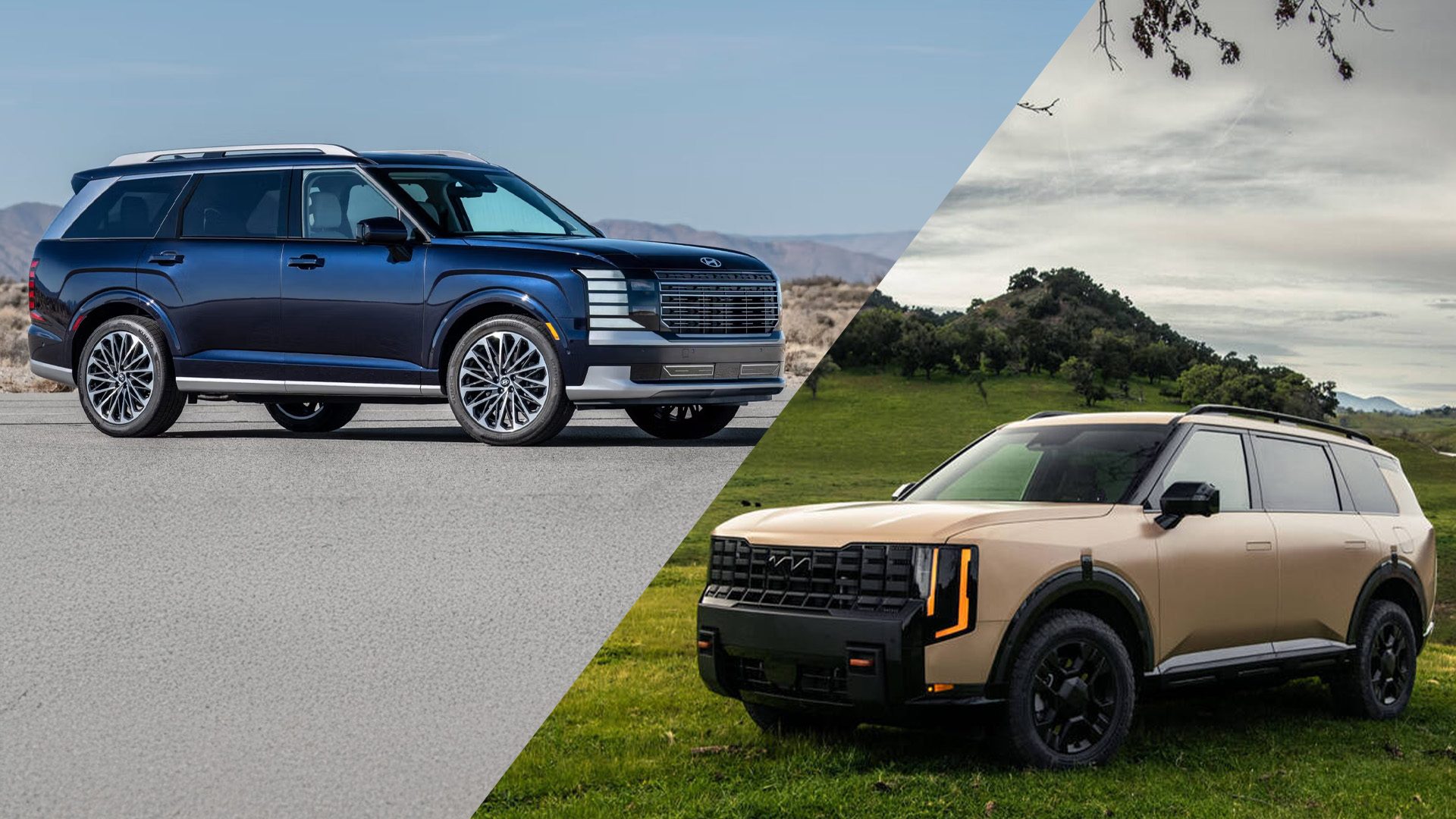
- Telluride: Kia’s “Opposites United” design language shows up as a boxier front end with a big grille, amber running lights, and a rear end that draws comparisons to Range Rover and Kia’s own EV9 electric SUV. The X-Pro trim leans into a rugged, Colorado-outdoors persona with tow hooks, all-terrain tires, and available 21-inch wheels. Look closely at the fenders and you’ll notice a distinctive character line running down to an index mark at each wheel well — a deliberately unconventional touch Kia’s design team added on purpose.
- Palisade: Hyundai’s redesign leans more upscale and formal — vertically stacked, cascading rectangular daytime running lights, minimal body cladding, upright A-pillars, and a cleaner, less adventure-oriented overall stance. It reads more like a luxury SUV wearing a Hyundai badge, while the Telluride reads more like an adventure vehicle wearing a Kia badge.
Both got noticeably bigger, and in fact the new Telluride’s stretched wheelbase is an exact match for the Palisade’s — no surprise, since they share a platform. But the Telluride wears the size differently: the rugged, X-Pro-capable persona gives it a bit more visual personality and versatility than the Palisade’s more conservative, boardroom-ready look.
Mechanical & Practical Differences
- Dimensions: Both grew by roughly the same amount (2.3 inches longer overall, 2.7 inches more wheelbase versus their prior generations), so cabin space and legroom gains are comparable.
- Transmissions: Gas Telluride uses an 8-speed automatic; the Telluride hybrid uses a 6-speed. Palisade mirrors this exactly — 8-speed for the V6, 6-speed for the hybrid.
- AWD systems: Palisade’s HTRAC AWD is standard on the off-road-oriented XRT Pro trim and optional elsewhere, adding about $2,000. Telluride’s AWD is optional across the lineup as well, with the X-Pro trim built around all-terrain capability rather than outright off-roading.
- Braking/handling: Early testing on the new Telluride found it actually stops shorter than its predecessor despite gaining weight — a small but real mechanical improvement, and one that speaks well of the retuned chassis.
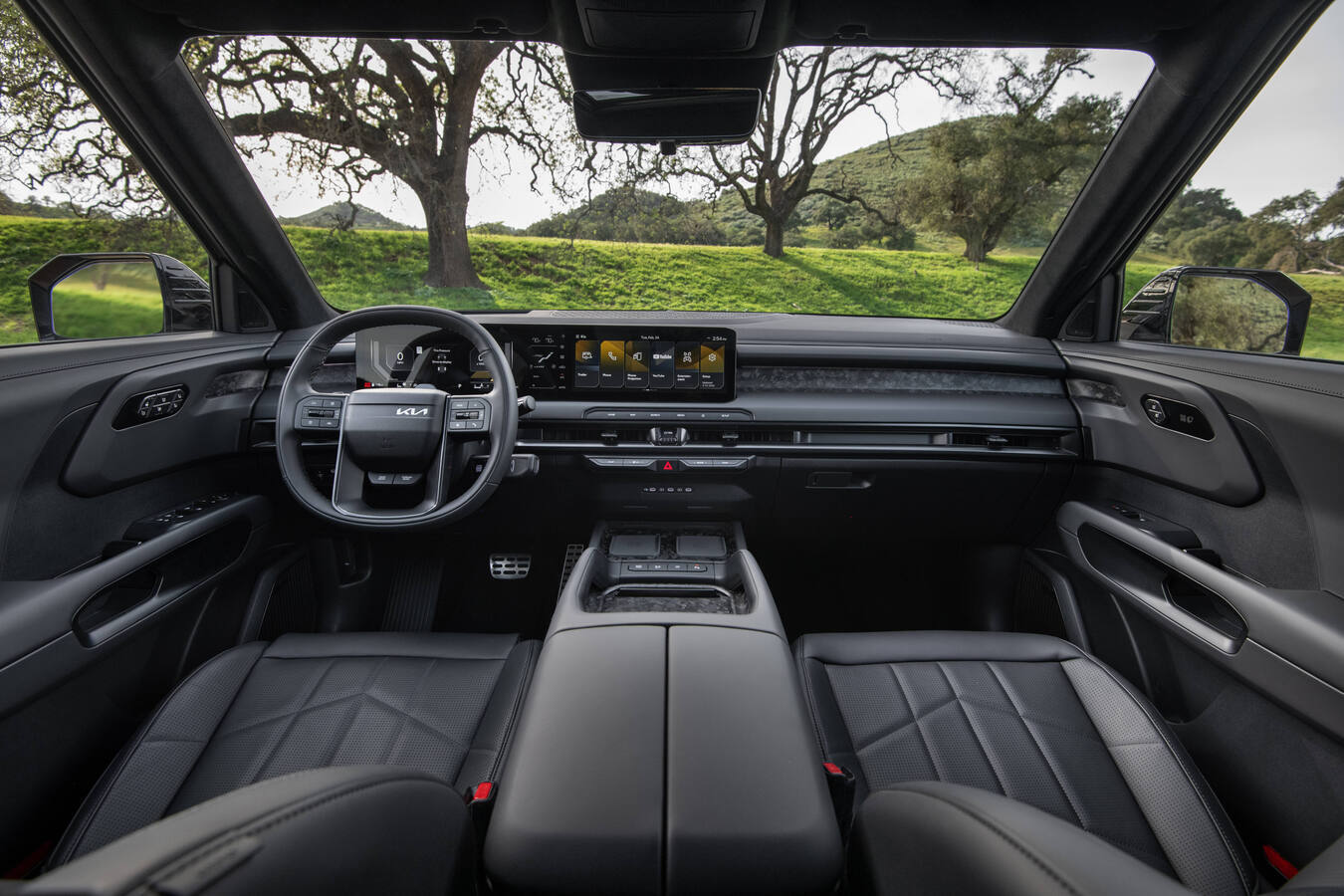
- Interior tech: Both offer dual 12.3-inch displays as the standard setup, but Kia goes a step further with an available panoramic display stretching nearly 30 inches — the more premium tech option of the two lineups.
Pricing
Kia’s 2027 Telluride spans nine gas trims from roughly $39,190 up to $56,790 for a loaded X-Pro SX Prestige, with hybrid pricing expected to land in the mid-$40,000s and up.
Hyundai hasn’t finalized 2027 Palisade pricing at the time of writing, but since it’s a second-year carryover of the 2026 redesign, expect it to hold close to current levels rather than jump — with the Hybrid SEL Premium trim (around $47,500) widely considered the best value in the lineup.
So Which One Should You Actually Buy?
Both are solid three-row SUVs, and it’s easy to see why families have cross-shopped these two for years. But when you line up the details for 2027 specifically, the Telluride has the stronger case:
- It’s the newer platform. A full ground-up redesign versus a second-year carryover means the Telluride benefits from the latest version of everything the two brands share — chassis tuning, materials, tech.
- It’s quicker and more efficient across the board. The standard turbo-four beats the Palisade’s base V6 to 60 mph and at the pump, and the Telluride hybrid posts better combined mpg than the Palisade hybrid.
- It brings more personality to the segment. Between the standard trims and the X-Pro’s rugged, capable styling, the Telluride offers a wider range of looks — including a genuinely adventure-ready option the Palisade lineup doesn’t really match.
- Towing needs are covered either way, with the gas Telluride matching the segment-leading 5,000-lb rating.
If you’re set on the Palisade, the hybrid is the trim worth considering — just know you’re looking at last year’s redesign paired with a base engine (the V6) that Kia’s own engineers decided to retire. For most families cross-shopping this segment in 2027, the Telluride is the easier recommendation, and it’s worth a test drive to see how it feels in person.
References
- Autoblog, “2027 Kia Telluride Review, Specs, Pricing, and Warranty”
- Autoblog, “2027 Hyundai Palisade Review, Specs, Pricing, and Warranty”
- Car and Driver, “Take a Look at the Redesigned 2027 Kia Telluride”
- Car and Driver, “2026 Hyundai Palisade Hybrid Is New, More Efficient, Adds 42 HP”
- Car and Driver, “2026 Hyundai Palisade Revealed in New York with V-6 and Hybrid Powertrains”
- Kelley Blue Book, “Kia Teases (Well, Mostly Reveals) 2027 Telluride”
- CarsDirect, “2027 Hyundai Palisade Preview: Specs, Price, Release Date”
- Edwards Kia, “2027 Kia Telluride Technical Spec”
- StockTitan, “All-New 2026 Hyundai Palisade SUV Makes ‘Bigger, Better, Further’ Debut”
FAQ
Does the 2027 Kia Telluride still offer a V6? No. Kia dropped the naturally aspirated V6 entirely for 2027 in favor of a 274-hp turbocharged four-cylinder and a 329-hp turbo-hybrid.
Is the Hyundai Palisade V6 worth getting over the hybrid — or over the Telluride? Not really, from a pure value standpoint. The V6 is slower to 60 mph and less fuel-efficient than Kia’s turbo-four, and it’s the older of the two powertrain approaches on the market right now. Kia’s own engineers moved past the V6 entirely for 2027, which tells you something about where the segment is headed.
Which one is quicker? The Telluride’s standard turbo-four gets to 60 mph in about 7.4 seconds — quicker than the Palisade’s base V6, which needs anywhere from 7.9 to 8.8 seconds depending on trim.
Are the Telluride and Palisade related? Yes. Both are built by Hyundai Motor Group and share a platform, wheelbase dimensions, and — in hybrid form — an essentially identical powertrain. They’re styled and tuned differently by each brand’s design and engineering teams.
Which one is bigger inside? They’re very close. Both grew by the same amount in this redesign cycle (2.3 inches longer, 2.7-inch longer wheelbase), so interior space is comparable rather than a deciding factor either way.
How much can each one tow? Up to 5,000 lbs with either gas engine (Telluride turbo-four or Palisade V6). The hybrid versions max out lower — around 4,000 lbs for the Palisade hybrid.
Is the hybrid version worth the extra cost on either SUV? For most daily drivers, yes. The mpg jump is substantial — low-to-mid 30s combined versus low-to-mid 20s for the gas engines — and the hybrid actually produces more horsepower than either brand’s standard engine.